a20d2a05e9
Previously conflated two different kinds of constraint:
  - operational deadbands (|T_c - T_c0| <= 5 F) used by the DRC for mode
    transitions. Symmetric bands around setpoint. Violating these is an
    operator/operational issue, not a safety issue.
  - safety limits (T_f <= 1200 C, T_c <= 320 C, n <= 1.15, etc.) are
    hard one-sided halfspaces corresponding to physical damage mechanisms
    or reactor-trip setpoints. THESE are what a safety barrier/reach must
    discharge.

predicates.json now has three groups:
  - operational_deadbands (t_avg_above_min, t_avg_in_range, p_above_crit)
  - safety_limits (fuel_centerline, t_avg_high_trip, t_avg_low_trip,
    n_high_trip, n_low_operation, cold_leg_subcooled)
  - mode_invariants (inv1_holds, inv2_holds as conjunctions of safety_limits)

reach_operation.m and barrier_lyapunov.m both now report halfspace-by-
halfspace margins against inv2_holds. Attributable failure analysis:
we can see WHICH limit is tightest.

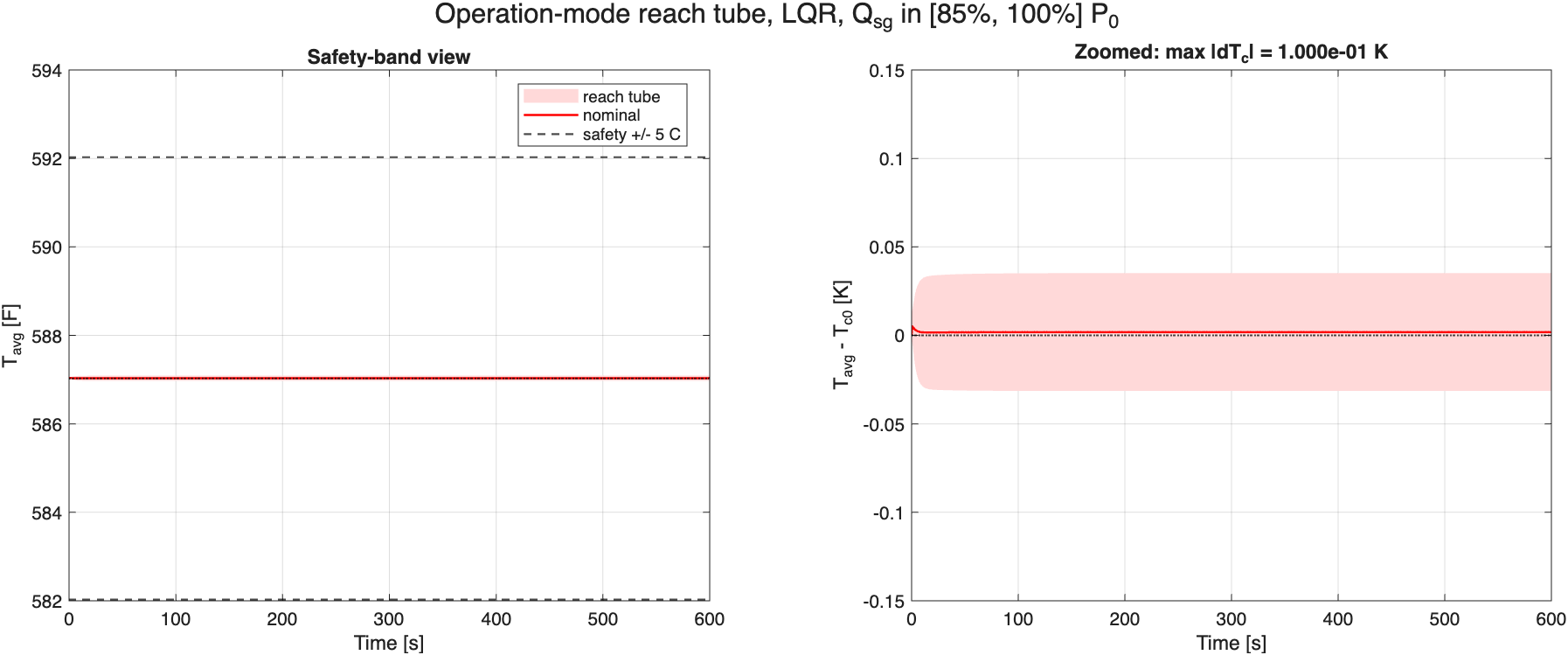
Reach tube (under +/-15% Q_sg load): passes all 6 safety halfspaces.
Tightest margin is n_high_trip at +0.138 (12% from trip). Temperature
directions have 10-870 K margin.

Lyapunov barrier (same): fails all 6. Worst is n_high_trip with -2365
margin — the ellipsoid says n could deviate by +/-2364, which is
physically meaningless. Anisotropy cost made visible per-direction.
Motivates SOS / polytopic barriers for the thesis chapter.

load_predicates.m now returns .operational_deadbands, .safety_limits,
and .mode_invariants. Existing callers that only used .constants or
.t_avg_in_range still work because those live under the old keys.

Hacker-Split: user caught that the barrier was checking the wrong
invariant; safety limits != operating deadband. Restructured so the
proof target matches the physical claim.

Co-Authored-By: Claude Opus 4.7 (1M context) <noreply@anthropic.com>
62 KiB
1794x749px
62 KiB
1794x749px